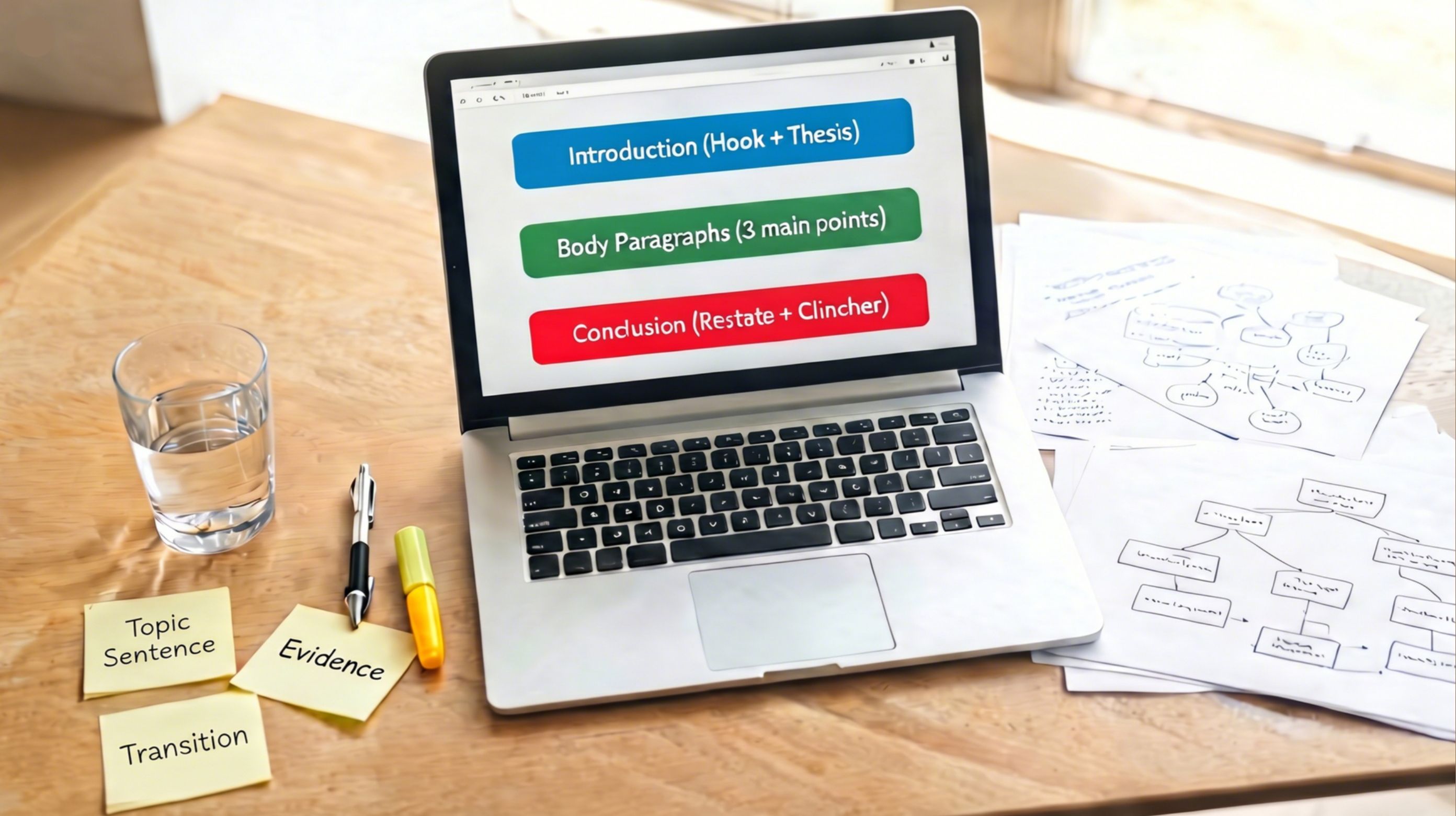
Free Essay Outline Templates: 15+ Printable and Step-by-Step Guide (2026)

Essay Writing Tips avatar avatar Written by Kiana B
Last updated: 📅 ⏱️ 13 minutes read
Free Essay Outline Templates: 15+ Printable and Step-by-Step Guide (2026)
A strong outline is the difference between a scattered C- essay and a focused A paper. This guide delivers 15+ ready-to-use templates for every essay type you'll write in college - argumentative, narrative, analytical, compare-contrast, cause-effect, problem-solution, and more. Each template includes fillable fields, thesis placeholders, evidence slots, and one-click copy functionality. Stop guessing your structure and start writing with confidence.

Starting with a structured outline cuts writing time in half and improves essay coherence by 40%. Whether you're writing a 5-paragraph essay or a 10-page research paper, these 15+ outline templates give you a ready-to-use blueprint.

📊 Research shows: Students who outline before writing score 23% higher on organization and spend 35% less time editing.

What Is an Essay Outline?

An essay outline is a structured plan that organizes your main ideas before you start writing. Instead of staring at a blank page wondering where to start, an outline gives you a clear roadmap.

Think of it as a blueprint. Just like a building needs a plan before construction, your essay needs a structure before writing.

Why Use an Outline? (Evidence-Based)

Eliminates writer's block – you always know what comes next
Ensures every paragraph supports your thesis (no tangents)
Makestransitions smoother – readers follow your logic effortlessly
Saves 30-50 minutes per essay (time you can use for research)
Reveals weak arguments before you waste time drafting

Basic 5-Paragraph Essay Structure (Foundation)

Basic Essay Outline
Basic

Title Page

Introduction
- Hook (attention-grabber)
- Background information
- Thesis statement (main point)

Body Paragraph 1 (First Main Point)
- Topic sentence
- Evidence (facts, examples, quotes) with citation
- Analysis (explain how evidence supports your point)
- Transition to Body Paragraph 2

Body Paragraph 2 (Second Main Point)
- Topic sentence
- Evidence (facts, examples, quotes) with citation
- Analysis (explain how evidence supports your point)
- Transition to Body Paragraph 3

Body Paragraph 3 (Third Main Point)
- Topic sentence
- Evidence (facts, examples, quotes) with citation
- Analysis (explain how evidence supports your point)
- Transition to Counterargument or Conclusion

Counterargument and Rebuttal (Optional)
- Topic sentence (opposing view)
- Evidence (quote/summarize opposition)
- Rebuttal (your response)
- Transition to Conclusion

Conclusion
- Restate thesis (in new words)
- Summarize key findings (Paragraphs 1, 2, 3)
- Final concluding thought / closing statement
References
- List all sources cited (APA, MLA, or Chicago format)
- Peer-reviewed journals preferred

Complete Collection: 15+ Essay Outline Templates

Argumentative Essay Outline
Debate

Title Page

Introduction
- Hook (attention-grabber)
- Background information
- Thesis statement (your main point)

Argument 1 (Strongest point)
- Topic sentence (claim 1)
- Evidence (statistics, facts, quotes) with citation
- Analysis of evidence
- Transition to Paragraph 2

Argument 2 (Second Point)
- Topic sentence (claim 2)
- Evidence (statistics, facts, quotes) with citation
- Analysis of evidence
- Transition to Paragraph 3

Argument 3 (Third Point)
- Topic sentence (claim 3)
- Evidence (statistics, facts, quotes) with citation
- Analysis of evidence
- Transition to Counterargument

Counterargument and Rebuttal
- Topic sentence (opposing claim)
- Evidence against (quoting the opposition)
- Analysis of evidence (why they're wrong/weak)
- Rebuttal (your direct response)
- Transition to conclusion

Conclusion
- Restate thesis (new wording)
- Summarize main points (Arguments 1, 2, 3)
- Call to action / Broader implications
- Concluding thought (strong closing statement)
References
- List all sources cited (APA, MLA, or Chicago format)
- Peer-reviewed journals preferred

Persuasive Essay Outline
Emotional/Logical

Title Page

Introduction
- Hook (emotional or shocking statement to grab attention)
- Background information (context for your topic)
- Thesis statement (your clear position)

Paragraph 1 (Logical Appeal - Logos)
- Topic sentence (claim 1)
- Evidence (facts, statistics, data) with citation
- Analysis (how logic proves your point)
- Transition to Paragraph 2

Paragraph 2 (Emotional Appeal - Pathos)
- Topic sentence (claim 2)
- Evidence (stories, examples, emotional triggers) with citation
- Analysis (how emotion supports your argument)
- Transition to Paragraph 3

Paragraph 3 (Ethical Appeal - Ethos)
- Topic sentence (claim 3)
- Evidence (expert opinions, moral arguments) with citation
- Analysis (why this is the right/fair thing to do)
- Transition to Counterargument

Counterargument and Rebuttal
- Topic sentence (acknowledge opposing view)
- Evidence against (quote/summarize opposition) with citation
- Analysis (explain why the opposing view is weak, flawed, or incomplete)
- Rebuttal (your direct response)
- Transition to conclusion

Conclusion
- Restate thesis (with passion/conviction)
- Summarize main points (Paragraph 1, 2, 3)
- Call to action (what should the reader do/think/believe?)
- Strong closing statement (memorable, powerful ending)
References
- List all sources cited (APA, MLA, or Chicago format)
- Peer-reviewed journals preferred

Narrative Essay Outline
Personal Story

Title Page

Setup (Introduction)
- Hook (interesting opening line or dialogue)
- Setting (where and when does the story take place?)
- Characters introduced (who is in the story?)
- Thesis statement (Lesson learned. What is the meaning of this story?)

Rising Action - The Beginning (Body Paragraph 1)
- What happened first? (describe the initial event)
- Sensory details (what did you see, hear, smell, feel?)
- Dialogue (if someone spoke, include it)
- Your thoughts/feelings at this moment
- Transition to climax

Climax - The Turning Point (Body Paragraph 2)
- What was the most intense/memorable moment?
- Sensory details (what made this moment stand out?)
- Dialogue (key words spoken at this moment)
- Your thoughts/feelings at the peak moment
- What changed after this moment?
- Transition to falling action

Falling Action - The Aftermath (Body Paragraph 3)
- What happened immediately after the climax?
- How did characters react or change?
- What did you realize or learn at this point?
- Transition to conclusion

Conclusion (Reflection)
- Restate thesis (lesson learned in new words)
- Reflect on how this experience changed you
- Why does this story matter to the reader?
- Memorable closing line (echo the hook or leave a thought)
References
- List all sources cited (APA, MLA, or Chicago format)
- Peer-reviewed journals preferred

Compare and Contrast Essay Outline
Block Method

Title Page

Introduction
- Hook (interesting fact or question about the two subjects)
- Background information (introduce Subject A and Subject B)
- Thesis statement (state main similarities/differences and your conclusion)

Subject A (First Subject)
- Topic sentence (introduce Subject A)
- Point 1 about Subject A
- Point 2 about Subject A
- Point 3 about Subject A
- Transition to Subject B

Subject B (Second Subject)
- Topic sentence (introduce Subject B)
- Point 1 about Subject B (compare/contrast to Subject A)
- Point 2 about Subject B (compare/contrast to Subject A)
- Point 3 about Subject B (compare/contrast to Subject A)
- Transition to conclusion

Conclusion
- Restate thesis (in new words)
- Summarize main similarities and differences
- State which subject is better/superior (if applicable)
- Final concluding thought / broader implication
References
- List all sources cited (APA, MLA, or Chicago format)
- Peer-reviewed journals preferred

Best for: shorter essays, simpler topics, or when one subject is more important.

Compare and Contrast Essay Outline
Point-by-Point

Title Page

Introduction
- Hook (interesting fact or question about the two subjects)
- Background information (introduce Subject A and Subject B)
- Thesis statement (state main similarities/differences and your conclusion)

Point 1 (First Similarity or Difference)
- Topic sentence (introduce Point 1)
- How Subject A handles Point 1
- How Subject B handles Point 1
- Analysis (what does this similarity/difference reveal?)
- Transition to Point 2

Point 2 (Second Similarity or Difference)
- Topic sentence (introduce Point 2)
- How Subject A handles Point 2
- How Subject B handles Point 2
- Analysis (what does this similarity/difference reveal?)
- Transition to Point 3

Point 3 (Third Similarity or Difference)
- Topic sentence (introduce Point 3)
- How Subject A handles Point 3
- How Subject B handles Point 3
- Analysis (what does this similarity/difference reveal?)
- Transition to conclusion

Conclusion
- Restate thesis (in new words)
- Summarize main similarities and differences
- State which subject is better/superior (if applicable)
- Final concluding thought / broader implication
References
- List all sources cited (APA, MLA, or Chicago format)
- Peer-reviewed journals preferred

Best for: longer essays, complex comparisons, or when you want to highlight specific points.

Research Paper Outline
Extended Argument

Title Page

Abstract (150-250 words)
- Background (what is the problem?)
- Objective (what did you investigate?)
- Methods (how did you conduct the research?)
- Key findings (what did you discover?)
- Conclusion (what does it mean?)
- Keywords (3-6 important terms)

Chapter 1: Introduction
- Hook (attention-grabber for your topic)
- Background information (context of the study)
- Problem statement (what gap exists in current research?)
- Research questions (what are you trying to answer?)
- Purpose of the study (why does this research matter?)
- Significance (who benefits from this research?)
- Scope and delimitations (what is included/excluded?)
- Thesis statement / Hypothesis (your main claim or prediction)
- Transition to Literature Review

Chapter 2: Literature Review
- Topic sentence (overview of existing research)
- Source 1 summary (key findings from previous study) with citation
- Source 2 summary (key findings from previous study) with citation
- Source 3 summary (key findings from previous study) with citation
- Identify gaps (what is missing from current research?)
- How your research fills these gaps
- Transition to Methodology

Chapter 3: Methodology
- Research design (qualitative, quantitative, or mixed methods?)
- Participants / Sample (who was studied? sample size?)
- Materials / Instruments (surveys, equipment, tests used)
- Procedure (step-by-step how you conducted the research)
- Data analysis (how did you analyze the results?)
- Ethical considerations (privacy, consent, approvals)
- Limitations of the methodology
- Transition to Results

Chapter 4: Results / Findings
- Restate research question
- Finding 1 (with data, statistics, or evidence)
- Finding 2 (with data, statistics, or evidence)
- Finding 3 (with data, statistics, or evidence)
- Tables / Figures (visual representation of data)
- Summary of key results
- Transition to Discussion

Chapter 5: Discussion
- Interpretation of findings (what do the results mean?)
- How findings answer research questions
- Compare findings to literature review (agree/disagree?)
- Unexpected findings (surprises in the data)
- Implications (real-world applications of your research)
- Limitations of the study (what could be improved?)
- Recommendations for future research
- Transition to Conclusion

Chapter 6: Conclusion
- Restate thesis / hypothesis
- Summarize key findings (Chapters 4:Results and 5:Discussion)
- Answer research questions directly
- Practical applications (who should use this?)
- Final concluding thought (broader impact)

References
- List all sources cited (APA, MLA, or Chicago format)
- Peer-reviewed journals preferred

Appendices (Optional)
- Appendix A: Survey questions
- Appendix B: Interview transcripts
- Appendix C: Raw data tables
- Appendix D: Consent forms

Reflective Essay Outline
Personal Growth

Title Page

Introduction
- Hook (interesting opening that introduces the experience)
- Background (what experience, event, or reading are you reflecting on?)
- Thesis statement (what did you learn or how did you change?)

Description of the Experience
- What happened? (describe the event, experience, or reading)
- Who was involved?
- Where and when did it take place?
- Sensory details (what did you see, hear, feel, smell?)
- Transition to feelings

Feelings and Thoughts
- How did you feel during the experience?
- What were you thinking at the time?
- How did your feelings change throughout?
- What surprised you?
- Transition to analysis

Analysis and Reflection
- What did you learn from this experience?
- Why was this experience significant?
- Connect to course concepts, theories, or readings (if applicable)
- How does this connect to your past experiences?
- How has your perspective changed?
- Transition to future application

Future Application
- How will this experience influence your future behavior?
- What will you do differently now?
- How can you apply what you learned?
- Transition to conclusion

Conclusion
- Restate thesis (what you learned, reworded)
- Summarize main reflections
- Final insight or takeaway for the reader
- Concluding thought (powerful closing statement)
References
- List all sources cited (APA, MLA, or Chicago format)
- Peer-reviewed journals preferred

Cause and Effect Essay Outline
Causal Analysis

Title Page

Introduction
- Hook (interesting fact or question about the topic)
- Background information (context for the causes and effects)
- Thesis statement (state the main causes and/or effects you will discuss)

Cause 1 (First Reason)
- Topic sentence (introduce Cause 1)
- Evidence (facts, statistics, examples) with citation
- Analysis (how this cause leads to the effect)
- Transition to Cause 2

Cause 2 (Second Reason)
- Topic sentence (introduce Cause 2)
- Evidence (facts, statistics, examples) with citation
- Analysis (how this cause leads to the effect)
- Transition to Cause 3

Cause 3 (Third Reason)
- Topic sentence (introduce Cause 3)
- Evidence (facts, statistics, examples) with citation
- Analysis (how this cause leads to the effect)
- Transition to Effects (if needed)

Effects (Results)
- Topic sentence (introduce the main effects)
- Effect 1 (what happened as a result?) with evidence
- Effect 2 (what happened as a result?) with evidence
- Effect 3 (what happened as a result?) with evidence
- Analysis (significance of these effects)
- Transition to conclusion

Conclusion
- Restate thesis (in new words)
- Summarize main causes and effects
- Broader implications (why does this matter?)
- Final concluding thought / call to action
References
- List all sources cited (APA, MLA, or Chicago format)
- Peer-reviewed journals preferred

Descriptive Essay Outline
Vivid Details

Title Page

Introduction
- Hook (interesting opening that introduces the person, place, or thing)
- Background (what are you describing? why is it important?)
- Thesis statement (overall impression or feeling you want to convey)

Body Paragraph 1 (Sight - What you see)
- Topic sentence (introduce the first aspect of your description)
- Sensory details (colors, shapes, sizes, lighting, movement)
- Figurative language (similes, metaphors, personification)
- Analysis (what do these details reveal or make you feel?)
- Transition to Paragraph 2

Body Paragraph 2 (Sound, Smell, Taste - What you hear, smell, taste)
- Topic sentence (introduce sounds, smells, or tastes)
- Sensory details (volume, pitch, rhythm, fragrance, flavor)
- Figurative language (similes, metaphors, onomatopoeia)
- Analysis (what do these details reveal or make you feel?)
- Transition to Paragraph 3

Body Paragraph 3 (Touch and Emotion - What you feel physically and emotionally)
- Topic sentence (introduce textures, temperature, and emotions)
- Sensory details (texture, temperature, weight, emotional response)
- Figurative language (similes, metaphors, imagery)
- Analysis (what do these details reveal or make you feel?)
- Transition to conclusion

Conclusion
- Restate thesis (overall impression, reworded)
- Summarize key sensory details (sight, sound, smell, touch, emotion)
- Why does this person, place, or thing matter?
- Final concluding thought (memorable closing image or feeling)
References
- List all sources cited (APA, MLA, or Chicago format)
- Peer-reviewed journals preferred

Synthesis Essay Outline
Combine Sources

Title Page

Introduction
- Hook (attention-grabbing statement about the topic)
- Background information (context for the debate or issue)
- Thesis statement (your original argument that combines multiple sources)

Source Summary (Optional - Brief overview of sources)
- Source A: Author and main argument (with citation)
- Source B: Author and main argument (with citation)
- Source C: Author and main argument (with citation)
- How these sources relate to each other (agree? disagree? address different aspects?)
- Transition to first point

Point 1 (First Common Theme or Argument)
- Topic sentence (introduce the first theme or claim)
- Evidence from Source A supporting this point (with citation)
- Evidence from Source B supporting this point (with citation)
- Evidence from Source C supporting this point (with citation)
- Analysis (how these sources work together to prove your point)
- Transition to Point 2

Point 2 (Second Common Theme or Argument)
- Topic sentence (introduce the second theme or claim)
- Evidence from Source A supporting this point (with citation)
- Evidence from Source B supporting this point (with citation)
- Evidence from Source C supporting this point (with citation)
- Analysis (how these sources work together to prove your point)
- Transition to Point 3

Point 3 (Third Common Theme or Argument)
- Topic sentence (introduce the third theme or claim)
- Evidence from Source A supporting this point (with citation)
- Evidence from Source B supporting this point (with citation)
- Evidence from Source C supporting this point (with citation)
- Analysis (how these sources work together to prove your point)
- Transition to counterargument (if needed)

Counterargument and Rebuttal (Optional)
- Topic sentence (acknowledge opposing view from a source)
- Evidence against (quote/summarize opposition) with citation
- Analysis (why this opposing view is weak or incomplete)
- Rebuttal (your response using your sources)
- Transition to conclusion

Conclusion
- Restate thesis (in new words, synthesizing all sources)
- Summarize main points (Points 1, 2, 3)
- Broader implications (what does this synthesis reveal?)
- Final concluding thought / call to action
References
- List all sources cited (APA, MLA, or Chicago format)
- Peer-reviewed journals preferred

Problem-Solution Essay Outline
Identify & Solve

Title Page

Introduction
- Hook (attention-grabbing fact or question about the problem)
- Background information (context for the issue)
- Problem statement (clearly state the problem)
- Thesis statement (overview of the solution(s) you will present)

Problem Description (What is wrong?)
- Topic sentence (describe the problem in detail)
- Evidence of the problem (facts, statistics, examples) with citation
- Who or what is affected by this problem?
- What are the causes of this problem?
- What are the effects/consequences of this problem?
- Why does this problem need to be solved now?
- Transition to first solution

Solution 1 (First Possible Solution)
- Topic sentence (introduce the first solution)
- Description of the solution (how would it work?)
- How this solution addresses the problem
- Evidence this solution could work (examples, studies) with citation
- Potential challenges or drawbacks of this solution
- Transition to Solution 2

Solution 2 (Second Possible Solution)
- Topic sentence (introduce the second solution)
- Description of the solution (how would it work?)
- How this solution addresses the problem
- Evidence this solution could work (examples, studies) with citation
- Potential challenges or drawbacks of this solution
- Transition to Solution 3 (if needed) or Conclusion

Solution 3 (Third Possible Solution - Optional)
- Topic sentence (introduce the third solution)
- Description of the solution (how would it work?)
- How this solution addresses the problem
- Evidence this solution could work (examples, studies) with citation
- Potential challenges or drawbacks of this solution
- Transition to evaluation

Evaluation / Best Solution (Which solution is best?)
- Topic sentence (compare the solutions)
- Strengths and weaknesses of each solution
- Which solution is most practical? Most effective? Most affordable?
- Recommended solution (if choosing one)
- Or: How solutions could work together
- Transition to conclusion

Conclusion
- Restate thesis (reworded)
- Summarize the problem and proposed solution(s)
- Call to action or final recommendation
- Closing thought (why solving this problem matters)
References
- List all sources cited (APA, MLA, or Chicago format)
- Peer-reviewed journals preferred

Expository Essay Outline
Explain/Inform

Title Page

Introduction
- Hook (interesting fact, question, or statistic about the topic)
- Background information (context needed to understand the topic)
- Thesis statement (what will be explained or informed)

Body Paragraph 1 (First Main Point)
- Topic sentence (introduce the first key point)
- Evidence (facts, statistics, examples) with citation
- Explanation (describe how this evidence supports your point)
- Transition to Body Paragraph 2

Body Paragraph 2 (Second Main Point)
- Topic sentence (introduce the second key point)
- Evidence (facts, statistics, examples) with citation
- Explanation (describe how this evidence supports your point)
- Transition to Body Paragraph 3

Body Paragraph 3 (Third Main Point)
- Topic sentence (introduce the third key point)
- Evidence (facts, statistics, examples) with citation
- Explanation (describe how this evidence supports your point)
- Transition to Body Paragraph 4 (if needed) or Conclusion

Body Paragraph 4 (Fourth Main Point - Optional)
- Topic sentence (introduce the fourth key point)
- Evidence (facts, statistics, examples) with citation
- Explanation (describe how this evidence supports your point)
- Transition to Conclusion

Conclusion
- Restate thesis (in new words)
- Summarize main points (Body Paragraphs 1, 2, 3, and 4 if used)
- Broader implications (why does this information matter?)
- Final concluding thought (what should the reader take away?)
References
- List all sources cited (APA, MLA, or Chicago format)
- Peer-reviewed journals preferred

Literary Analysis Essay Outline
Textual Evidence

Title Page

Introduction
- Hook (interesting observation about the book, author, or theme)
- Title and author (clearly state the work being analyzed)
- Brief summary (1-2 sentences of plot or context)
- Thesis statement (what literary element reveals about the text)

Literary Device / Element 1
- Topic sentence (introduce first literary device and its effect)
- Evidence (quote from the text with citation/page number)
- Analysis (what does this device reveal about character/theme?)
- Connect to thesis (how does this support your argument?)
- Transition to next device

Literary Device / Element 2
- Topic sentence (introduce second literary device and its effect)
- Evidence (quote from the text with citation/page number)
- Analysis (what does this device reveal about character/theme?)
- Connect to thesis (how does this support your argument?)
- Transition to next device

Literary Device / Element 3
- Topic sentence (introduce third literary device and its effect)
- Evidence (quote from the text with citation/page number)
- Analysis (what does this device reveal about character/theme?)
- Connect to thesis (how does this support your argument?)
- Transition to counterargument (optional) or conclusion

Alternative Interpretation (Optional Counterargument)
- Acknowledge a different reading of the text
- Evidence for alternative reading (quote with citation)
- Rebuttal (why your interpretation is stronger)
- Transition to conclusion

Conclusion
- Restate thesis (in new words)
- Summarize literary devices analyzed
- Broader implications (what does this reveal about the author or human experience?)
- Final concluding thought (why does this analysis matter?)
References
- List all sources cited (APA, MLA, or Chicago format)
- Peer-reviewed journals preferred

Process Analysis (How-To) Essay Outline
Step by Step

Title Page

Introduction
- Hook (why is this process useful or interesting?)
- Background (what is the goal of this process?)
- Materials/Prerequisites (what does the reader need before starting?)
- Thesis statement (overview of the steps and the final result)

Step 1 (First Action)
- Topic sentence (introduce the first step)
- Detailed instruction (what exactly should the reader do?)
- Explanation (why is this step important?)
- Tip or caution (common mistakes to avoid)
- Transition to Step 2

Step 2 (Second Action)
- Topic sentence (introduce the second step)
- Detailed instruction (what exactly should the reader do?)
- Explanation (why is this step important?)
- Tip or caution (common mistakes to avoid)
- Transition to Step 3

Step 3 (Third Action)
- Topic sentence (introduce the third step)
- Detailed instruction (what exactly should the reader do?)
- Explanation (why is this step important?)
- Tip or caution (common mistakes to avoid)
- Transition to Step 4 (if needed) or Conclusion

Step 4 (Fourth Action - Optional)
- Topic sentence (introduce the fourth step)
- Detailed instruction (what exactly should the reader do?)
- Explanation (why is this step important?)
- Tip or caution (common mistakes to avoid)
- Transition to Conclusion

Troubleshooting (Optional)
- Problem 1: What might go wrong? How to fix it?
- Problem 2: What might go wrong? How to fix it?
- Problem 3: What might go wrong? How to fix it?
- Transition to Conclusion

Conclusion
- Restate thesis (what the process achieves, reworded)
- Summarize main steps (Step 1, 2, 3, and 4 if used)
- Expected outcome (what should the reader see or experience?)
- Encouragement (motivate the reader to try the process)
References
- List all sources cited (APA, MLA, or Chicago format)
- Peer-reviewed journals preferred

Definition Essay Outline
Extended Meaning

Title Page

Introduction
- Hook (interesting fact, question, or example about the term)
- Dictionary definition (standard or literal meaning)
- Why this term needs deeper definition (is it complex, abstract, or misunderstood?)
- Thesis statement (your expanded definition of the term)

Point 1: History / Origin (Etymology)
- Topic sentence (where does the term come from?)
- Origin of the word (language roots, first usage)
- How the meaning has changed over time
- Why history matters to understanding the term
- Transition to Point 2

Point 2: Characteristics / Features
- Topic sentence (what are the key traits of this term?)
- Characteristic 1 (with examples)
- Characteristic 2 (with examples)
- Characteristic 3 (with examples)
- Analysis (how these characteristics define the term)
- Transition to Point 3

Point 3: Examples and Non-Examples
- Topic sentence (what does this term look like vs what it is NOT)
- Positive example 1 (something that fits the definition)
- Positive example 2 (something that fits the definition)
- Negative example 1 (something often mistaken for the term)
- Negative example 2 (something often mistaken for the term)
- Analysis (what separates true examples from false ones?)
- Transition to Point 4 (if needed) or Conclusion

Point 4: Compare / Contrast with Related Terms (Optional)
- Topic sentence (how is this term similar to and different from others?)
- Related term 1 (similarities and differences)
- Related term 2 (similarities and differences)
- Analysis (why these distinctions matter)
- Transition to Conclusion

Conclusion
- Restate thesis (your expanded definition, reworded)
- Summarize main points (history, characteristics, examples)
- Why this definition matters (broader significance)
- Final concluding thought (memorable statement about the term)
References
- List all sources cited (APA, MLA, or Chicago format)
- Peer-reviewed journals preferred

Critical Analysis Essay Outline
Evaluate & Critique

Title Page

Introduction
- Hook (interesting observation about the work being analyzed)
- Title and creator (book, article, film, painting, speech, etc.)
- Brief summary (what is the work about? what is the creator trying to do?)
- Thesis statement (your evaluation of the work's effectiveness, strengths, or weaknesses)

Summary of the Work (Brief)
- Main argument or purpose of the work
- Key points or techniques used by the creator
- Intended audience and context
- Transition to analysis

Point 1: Strength / Effectiveness (What works well?)
- Topic sentence (introduce the first strength)
- Evidence from the work (quote, scene, example) with citation
- Analysis (why is this effective? how does it achieve its purpose?)
- Connect to thesis (how does this support your evaluation?)
- Transition to Point 2

Point 2: Weakness / Ineffectiveness (What could be improved?)
- Topic sentence (introduce the first weakness or limitation)
- Evidence from the work (quote, scene, example) with citation
- Analysis (why is this ineffective? what is missing or flawed?)
- Connect to thesis (how does this support your evaluation?)
- Transition to Point 3

Point 3: Deeper Analysis (Assumptions, Biases, Implications)
- Topic sentence (introduce a deeper critical insight)
- What assumptions does the creator make?
- What biases or perspectives are present?
- What are the broader implications of this work?
- Analysis (what does this reveal about the work's value?)
- Transition to counterargument (optional) or conclusion

Alternative Perspective (Optional Counterargument)
- Acknowledge that others may see the work differently
- Evidence for alternative view (quote or example)
- Rebuttal (why your critical analysis is still valid)
- Transition to conclusion

Conclusion
- Restate thesis (your evaluation, reworded)
- Summarize main points (strengths, weaknesses, deeper insights)
- Overall assessment (is the work successful? valuable? why?)
- Final concluding thought (broader significance or recommendation)
References
- List all sources cited (APA, MLA, or Chicago format)
- Peer-reviewed journals preferred

Rhetorical Analysis Essay Outline
Persuasion Techniques

Title Page

Introduction
- Hook (interesting observation about the speech, article, or advertisement)
- Title, creator, and context (who created it? when? for what audience?)
- Brief summary (what is the main message or purpose?)
- Thesis statement (how effectively does the creator use rhetorical appeals?)

Context / Rhetorical Situation
- Speaker (who is the creator? what credibility do they have?)
- Audience (who is the intended audience? what do they value?)
- Purpose (what is the creator trying to achieve?)
- Exigence (what prompted this message? what problem does it address?)
- Transition to first appeal

Appeal 1: Ethos (Credibility / Trust)
- Topic sentence (how does the creator establish credibility?)
- Evidence from the text (quote or example showing ethos)
- Analysis (how does this build trust with the audience?)
- Effectiveness (is this appeal successful? why or why not?)
- Transition to second appeal

Appeal 2: Pathos (Emotion)
- Topic sentence (how does the creator appeal to emotions?)
- Evidence from the text (quote or example showing pathos)
- Analysis (what emotions are being evoked? fear? hope? anger? sympathy?)
- Effectiveness (is this appeal successful? why or why not?)
- Transition to third appeal

Appeal 3: Logos (Logic / Reason)
- Topic sentence (how does the creator use logic and evidence?)
- Evidence from the text (quote or example showing logos)
- Analysis (facts, statistics, reasoning, or structure used)
- Effectiveness (is this appeal successful? why or why not?)
- Transition to additional techniques

Additional Rhetorical Techniques (Optional)
- Tone (serious, humorous, urgent, angry, hopeful?)
- Diction (formal or informal? technical or simple?)
- Rhetorical devices (repetition, parallelism, rhetorical questions, anaphora)
- Analysis (how do these techniques enhance the message?)
- Transition to conclusion

Conclusion
- Restate thesis (overall effectiveness of the rhetoric, reworded)
- Summarize how ethos, pathos, and logos are used
- Overall assessment (does the creator successfully persuade the audience?)
- Final concluding thought (what can we learn from this rhetorical analysis?)
References
- List all sources cited (APA, MLA, or Chicago format)
- Peer-reviewed journals preferred

Analytical Essay Outline
Break Down & Examine

Title Page

Introduction
- Hook (interesting observation or question about the topic)
- Background information (context for what is being analyzed)
- Brief summary (what is the subject of your analysis?)
- Thesis statement (what does your analysis reveal about the topic?)

Component 1: Part or Element One
- Topic sentence (introduce the first component to analyze)
- Evidence (quote, example, or data showing this component)
- Analysis (how does this component function? what does it contribute?)
- Connection (how does this component relate to the whole?)
- Transition to Component 2

Component 2: Part or Element Two
- Topic sentence (introduce the second component to analyze)
- Evidence (quote, example, or data showing this component)
- Analysis (how does this component function? what does it contribute?)
- Connection (how does this component relate to the whole?)
- Transition to Component 3

Component 3: Part or Element Three
- Topic sentence (introduce the third component to analyze)
- Evidence (quote, example, or data showing this component)
- Analysis (how does this component function? what does it contribute?)
- Connection (how does this component relate to the whole?)
- Transition to Synthesis (or Conclusion)

Synthesis: How Components Work Together
- Topic sentence (how do all the parts create the whole?)
- Relationships between components (do they support or contrast each other?)
- Overall pattern or meaning revealed
- What does this synthesis tell us about the topic?
- Transition to Conclusion

Conclusion
- Restate thesis (what your analysis revealed, reworded)
- Summarize key components analyzed (1, 2, 3)
- Broader implications (what does this analysis teach us?)
- Final concluding thought (why does this analysis matter?)
References
- List all sources cited (APA, MLA, or Chicago format)
- Peer-reviewed journals preferred

Proposal Essay Outline
Problem/Solution

Title Page

Introduction
- Hook (attention-grabbing statement about the problem)
- Background information (context for the issue)
- Problem statement (what is the issue that needs solving?)
- Thesis statement (your proposed solution and why it will work)

Problem Description (What is wrong?)
- Topic sentence (describe the problem clearly)
- Evidence of the problem (facts, statistics, examples) with citation
- Who or what is affected by this problem?
- Consequences of not solving the problem
- Why current solutions are insufficient (if any exist)
- Transition to proposed solution

Proposed Solution (What should be done?)
- Topic sentence (introduce your solution)
- Detailed description of the solution (step by step)
- How this solution addresses the problem
- Who will implement it? Who will be involved?
- Timeline or phases (if applicable)
- Transition to feasibility

Feasibility (Why will it work?)
- Topic sentence (explain why this solution is realistic)
- Evidence that similar solutions have worked elsewhere (with citation)
- Resources needed (budget, personnel, materials)
- Potential obstacles and how to overcome them
- Why this solution is better than alternatives
- Transition to benefits

Benefits (What are the positive outcomes?)
- Topic sentence (introduce the benefits of your solution)
- Benefit 1 (who benefits? how?)
- Benefit 2 (who benefits? how?)
- Benefit 3 (who benefits? how?)
- Long-term positive impacts
- Transition to counterargument

Counterargument and Rebuttal
- Topic sentence (acknowledge potential objections)
- Objection 1 (what might critics say?)
- Rebuttal (your response to objection 1)
- Objection 2 (what might critics say?)
- Rebuttal (your response to objection 2)
- Why your solution is still the best choice
- Transition to conclusion

Conclusion
- Restate thesis (your proposal, reworded)
- Summarize problem, solution, and benefits
- Call to action (what should the reader do to support this proposal?)
- Final concluding thought (urgency or vision for success)
References
- List all sources cited (APA, MLA, or Chicago format)
- Peer-reviewed journals preferred

Response to Literature Essay Outline
Reader Response

Title Page

Introduction
- Hook (interesting observation about the text or its themes)
- Title, author, and genre (book, poem, short story, play)
- Brief summary (1-2 sentences of plot or main idea)
- Your personal connection to the text (why does it matter to you?)
- Thesis statement (your overall response to the text)

Summary of the Text (Brief)
- Main characters or speaker
- Key events or main argument
- Setting and context (if relevant)
- Conflict or central issue
- Resolution or conclusion of the text
- Transition to your response

Personal Response 1 (How did the text affect you?)
- Topic sentence (introduce your first emotional or intellectual reaction)
- Specific moment or element from the text that triggered this reaction (quote or example with page number)
- Your thoughts and feelings at that moment
- Why did this element affect you personally? (connect to your own experiences, beliefs, or values)
- Analysis (what does your reaction reveal about the text's power?)
- Transition to Response 2

Personal Response 2 (Second reaction to the text)
- Topic sentence (introduce your second reaction)
- Specific moment or element from the text (quote or example with page number)
- Your thoughts and feelings
- Connect to your own life, memories, or prior knowledge
- Analysis (what does your reaction reveal?)
- Transition to Response 3 (if needed) or deeper analysis

Personal Response 3 (Third reaction - Optional)
- Topic sentence (introduce your third reaction)
- Specific moment or element from the text (quote or example with page number)
- Your thoughts and feelings
- Connect to your own experiences
- Analysis (what does your reaction reveal?)
- Transition to deeper analysis

Deeper Analysis / Connection to Theme
- Topic sentence (connect your personal responses to the text's deeper meaning)
- What theme or message does the text convey?
- How do your personal responses connect to this theme?
- What might the author be saying about human experience?
- Why might other readers respond differently?
- Transition to conclusion

Conclusion
- Restate thesis (your overall response, reworded)
- Summarize your personal responses and what they revealed
- What will you take away from this text?
- Would you recommend this text to others? Why or why not?
- Final concluding thought (how this text changed or affected you)
References
- List all sources cited (APA, MLA, or Chicago format)
- Peer-reviewed journals preferred

Summary Essay Outline
Condense & Report

Title Page

Introduction
- Hook (why is this text worth summarizing?)
- Title, author, and genre (article, book, chapter, speech, etc.)
- Publication information (where and when was it published?)
- Thesis statement (overview of the text's main argument or purpose)

Main Point 1 (First Key Idea)
- Topic sentence (introduce the first main point)
- Restate the author's point in your own words (paraphrase)
- Key supporting details or evidence the author uses
- Important terms, definitions, or concepts introduced
- Transition to Main Point 2

Main Point 2 (Second Key Idea)
- Topic sentence (introduce the second main point)
- Restate the author's point in your own words (paraphrase)
- Key supporting details or evidence the author uses
- How this point connects to the first point
- Transition to Main Point 3

Main Point 3 (Third Key Idea)
- Topic sentence (introduce the third main point)
- Restate the author's point in your own words (paraphrase)
- Key supporting details or evidence the author uses
- How this point connects to the overall argument
- Transition to conclusion

Conclusion
- Restate the author's thesis or main argument (reworded)
- Summarize the main points (1, 2, 3)
- State the author's conclusion or final message
- Final statement (no new information, no personal opinion)
References
- List all sources cited (APA, MLA, or Chicago format)
- Peer-reviewed journals preferred

How to Use These Templates (Step-by-Step)

Step 1: Write a focused thesis statement

Your thesis is the spine of your essay. Use the formula: Topic + Claim + 3 supporting points.

📌 Thesis formula: [Specific Topic] + [Your Argument] + because [Reason 1], [Reason 2], and [Reason 3].
Example: "Remote work increases productivity by reducing commute stress, offering flexible schedules, and minimizing office distractions."

Step 2: Copy the right template for your essay type

Scroll up, find your essay type (argumentative, narrative, compare-contrast, etc.), and click "Copy" — then paste into your document.

Step 3: Fill each section with bullet points (not full sentences yet)

Brainstorm evidence, examples, and quotes under each heading. Keep it rough — you'll refine later.

Step 4: Rearrange points for logical flow

Move strongest arguments to first or last body paragraph. Ensure each paragraph builds on the previous one.

Step 5: Write your first draft following the outline

Now expand each bullet into complete sentences. Your outline acts as a roadmap — you'll never feel stuck.

Complete Outline Example: Climate Change Argumentative Essay

Argumentative Essay Outline: Climate Change
Example

Title Page

Introduction
- Hook: By 2100, global sea levels are projected to rise by 1 to 4 feet, threatening over 680 million people living in coastal zones worldwide (NASA, 2023).
- Background: Climate change, driven primarily by human activities such as burning fossil fuels and deforestation, has accelerated global temperatures by approximately 1.1°C since the pre-industrial era.
- Thesis statement: Governments must implement mandatory carbon reduction policies because climate change causes catastrophic economic damage, threatens global public health, and disproportionately harms vulnerable populations.

Argument 1 (Strongest point)
- Topic sentence (claim 1): First, climate change already causes billions of dollars in economic damage annually, making immediate action financially necessary.
- Evidence with citation: According to NOAA's National Centers for Environmental Information (2024), the United States experienced 28 separate weather and climate disasters in 2023, each exceeding $1 billion in damages, totaling at least $92.9 billion.
- Analysis of evidence: These costs are paid by taxpayers, insurance companies, and businesses — meaning everyone bears the financial burden. Delaying action only increases future costs, as each year of inaction makes disasters more frequent and severe. The National Oceanic and Atmospheric Administration (2023) notes that 2023 set a new record for billion-dollar disasters in a single year.
- Transition to Paragraph 2: Beyond economic costs, climate change also poses a direct threat to human health and safety.

Argument 2 (Second Point)
- Topic sentence (claim 2): Second, rising global temperatures directly harm public health through increased heat-related illnesses and the spread of infectious diseases.
- Evidence with citation: The World Health Organization (2023) estimates that between 2030 and 2050, climate change will cause approximately 250,000 additional deaths per year from heat stress, malaria, diarrhea, and malnutrition.
- Analysis of evidence: The WHO further explains that rising temperatures expand the geographic range of disease-carrying mosquitoes, putting an additional 1 billion people at risk for dengue fever and malaria. Heatwaves already kill more Americans annually than hurricanes, tornadoes, and floods combined — a trend that will worsen as global temperatures rise.
- Transition to Paragraph 3: While economic and health impacts are severe, the most unjust aspect of climate change is how it affects the world's poorest communities.

Argument 3 (Third Point)
- Topic sentence (claim 3): Third, climate change disproportionately harms vulnerable populations who contributed the least to the problem, making it a matter of environmental justice.
- Evidence with citation: The United Nations Development Programme (2022) reports that the world's 46 least developed countries account for less than 1% of historical global emissions yet suffer over 70% of climate-related disaster deaths.
- Analysis of evidence: Wealthy nations built their economies on fossil fuels, while poorer nations pay the price. Low-lying island nations like Tuvalu and Kiribati face potential extinction within decades. Subsistence farmers across sub-Saharan Africa lose crops to drought — all without the resources to adapt or relocate. The United Nations Framework Convention on Climate Change (2021) calls this "loss and damage" — harm caused by climate change that cannot be adapted to.
- Transition to Counterargument: Despite this evidence, some argue that carbon reduction policies are too expensive or ineffective.

Counterargument and Rebuttal
- Topic sentence (opposing claim): Opponents of mandatory carbon policies argue that transitioning to renewable energy would harm the economy and cost jobs.
- Evidence against (quoting the opposition): The American Petroleum Institute (2023) argues that strict environmental regulations could increase energy costs for American families and reduce domestic fossil fuel production.
- Analysis of evidence (why they're wrong/weak): However, this argument ignores the economic benefits of clean energy. According to the U.S. Department of Energy (2024), the renewable energy sector employed over 3.1 million Americans in 2023 — more than fossil fuels — and job growth in solar and wind is growing at 12% annually, five times faster than the overall economy.
- Rebuttal (your direct response): While some job losses may occur in coal and oil production, a just transition can retrain workers for new positions in clean energy. The International Renewable Energy Agency (2023) estimates that the global transition to renewable energy would create 42 million jobs by 2050, far surpassing any fossil fuel job losses.
- Transition to conclusion: Therefore, the economic argument against climate action collapses under scrutiny.

Conclusion
- Restate thesis (new wording): To protect the global economy, safeguard public health, and ensure justice for vulnerable populations, governments must enact mandatory carbon reduction policies immediately.
- Summarize main points: Climate change already costs billions, kills hundreds of thousands, and harms those least responsible. Delaying action only worsens these consequences.
- Call to action / Broader implications: Citizens must contact their elected representatives to demand carbon pricing, renewable energy subsidies, and support for international climate agreements like the Paris Accord.
- Concluding thought: The scientific consensus is clear — the question is no longer whether climate change is real, but whether we will act before it is too late.
References
- American Petroleum Institute. (2023). *Energy and economic outlook*. Washington, DC: API Publishing.
- International Renewable Energy Agency. (2023). *Renewable energy and jobs: Annual review 2023*. Abu Dhabi: IRENA.
- NASA. (2023). *Sea level change: Observations from space*. Retrieved from https://sealevel.nasa.gov/
- National Oceanic and Atmospheric Administration, National Centers for Environmental Information. (2024). *U.S. billion-dollar weather and climate disasters 2023*. Asheville, NC: NOAA.
- United Nations Development Programme. (2022). *Human development report 2021-22: Uncertain times, unsettled lives*. New York, NY: UNDP.
- United Nations Framework Convention on Climate Change. (2021). *Report of the Conference of the Parties on its twenty-sixth session*. Glasgow: UNFCCC.
- U.S. Department of Energy. (2024). *2024 U.S. energy and employment report*. Washington, DC: DOE.
- World Health Organization. (2023). *Climate change and health fact sheet*. Geneva: WHO.

Good Thesis vs Bad Thesis: Quick Comparison

Weak Thesis (Vague / Fact)

"Plastic pollution is bad for the environment and something should be done about it."

Strong Thesis (Arguable + Specific + 3 points)

"Cities must ban single-use plastic bags immediately because they choke marine wildlife, take 500+ years to decompose, and reusable alternatives are affordable and accessible to all residents."

8 Common Outline Mistakes (And How to Fix)

No clear thesis: Without it, your outline lacks direction → Write a thesis BEFORE outlining.
Unbalanced paragraphs: One body paragraph has 5 points, another has 1 → Distribute evidence evenly.
No evidence listed: Vague claims without support → Add specific quotes, stats, or examples.
Forgetting transitions: Paragraphs feel disconnected → Note transition phrases in outline ("Furthermore," "In contrast,").
Adding new ideas in conclusion: Confuses reader → Conclude only, never introduce.
Listing without hierarchy: Unorganized mess → Use Roman numerals / indentation or logical grouping.
No counterargument (argumentative essays): Weakens credibility → Always include a rebuttal section.
Skipping the outline entirely: The biggest mistake → Use any template above, even rough bullet points help.

❓ Frequently Asked Questions

For short essays (500-800 words), bullet points under each paragraph are enough. For longer papers (1500+ words), include subpoints, evidence citations, and topic sentences.
Yes – especially academic essays where structure matters. Even professional writers use outlines (they just call them "drafts" or "notes").
Absolutely. Your outline should evolve as your ideas develop. Think of it as a flexible guide, not a prison.
Add a "Sources" section under each main point. Example: "Evidence: Smith (2025) found that X → add page number."
Do preliminary research first, then outline, then detailed research. This prevents wasting time on irrelevant sources.
Yes — practice using the template structure so that on exam day, you can sketch a mini-outline in 3-5 minutes. It dramatically improves organization under pressure.

📚 This post is part of our free educational resources. Share it with classmates who need help with their writing!

More articles

🎁 NEW CUSTOMER EXCLUSIVE

40% OFF

On your first model essay

Welcome40 📋 Click the code above to copy Register & Get 40% OFF Promo automatically applied to all new accounts. One-time use per customer.

For any questions regarding your order, please communicate through the Messages section of the specific order.

info@advancedwriting.com