 AdvancedWriting
How to Write a Research Paper in 2 Weeks

 Written by
Emily B
Written by
Emily B
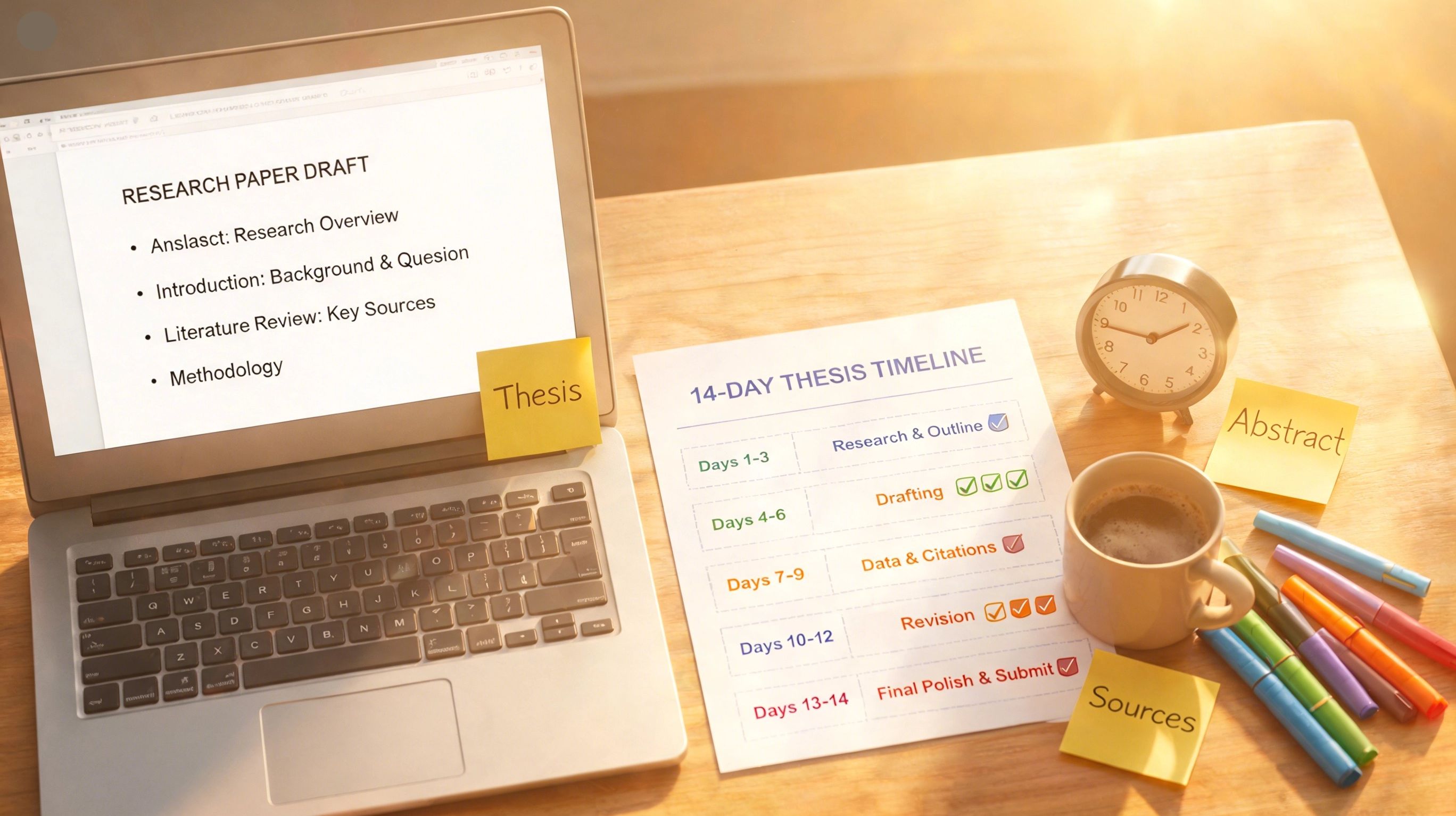
Writing a research paper can feel overwhelming, but breaking it down into manageable steps makes the process much easier. Whether you have two weeks or two months, this guide will walk you through every stage of writing a research paper, from choosing a topic to submitting your final draft.
📖 This guide includes a realistic 14-day timeline, a research log template, and citation management tips to help you stay organized.
The 14-Day Research Paper Timeline (Realistic)
Week 1: Foundation
Choose Topic & Start Research - Narrow your topic, find 5-10 preliminary sources, create a research question
Develop Thesis Statement - Write a clear, arguable thesis that guides your paper
Deep Research & Outline - Find 15-20 credible sources, create detailed outline with citations
Write Introduction & Body Paragraphs - Complete first 50% of first draft
Week 2: Writing & Revision
Complete First Draft - Finish all body paragraphs and conclusion
Take a Break - Step away to gain fresh perspective
Revise & Edit - Improve structure, arguments, and clarity
Format Citations & Proofread - Check formatting, grammar, and spelling
Final Review & Submit - One last read-through, print if needed, submit
Step 1: Choose Your Research Topic
How to pick a winning topic:
Start broad, then narrow: Instead of "Climate Change," try "The impact of plastic bans on ocean pollution in Southeast Asia"
Check source availability: Before committing, ensure you can find 10-15 credible sources
Consider your interest: You’ll spend hours on this paper—choose something that genuinely interests you
Ask a research question: Frame your topic as a question (e.g., "How does social media affect teenage mental health?")
Weak Topics vs Strong Topics
Weak Thesis
The InternetStrong Thesis
How social media algorithms influence political opinions among young adults.Weak Thesis
World War IIStrong Thesis
The role of codebreakers in shortening World War II.Weak Thesis
Mental healthStrong Thesis
The effectiveness of school-based mental health programs for adolescents.Step 2: Find Credible Sources
Where to find academic sources:
Google Scholar - Free academic search engine
JSTOR - Humanities and social sciences
PubMed - Medical and scientific research
Your university library database - Often free for students
Scopus or Web of Science - Advanced research databases
Research Log Template:
Step 3: Create a Strong Thesis Statement
Thesis Formula: Specific Topic + Your Claim + 3 Supporting Points = Strong Thesis
Weak Thesis Example:
The pandemic changed how people work." (Too vague, not arguable)Strong Thesis Example:
The COVID-19 pandemic accelerated remote work adoption by forcing companies to implement digital infrastructure, proving that productivity can be maintained outside traditional office settings, and changing employee expectations about work-life balance.Step 4: Develop a Detailed Research Paper Outline
Basic Essay Outline
Basic
Step 5: Write the First Draft
Write first, edit later. The goal of the first draft is to get your ideas on paper—not perfection.
Start with the easiest section: Don’t force yourself to write the introduction first
Use your outline as a roadmap: Each bullet point becomes a sentence or paragraph
Write without stopping: Set a timer for 25 minutes and write continuously
Don’t edit as you go: Save grammar fixes for later drafts
Cite as you write: Add citations immediately to avoid plagiarism
Step 6: Revise and Edit (The Magic Step)
Revision is what turns good papers into great papers.
Take a break first: Step away for 24 hours if possible
Focus on big-picture issues: Does each paragraph support your thesis? Is your argument logical?
Read aloud: You’ll catch awkward phrasing and missing transitions
Check paragraph flow: Add transition words between paragraphs
Cut unnecessary words: Remove redundancy and strengthen weak verbs
Get feedback: Have a peer or writing center review your paper
Step 7: Format Citations and Bibliography
Citation management tools save hours:
Zotero (Free) - Best for most students
Mendeley (Free) - Great for sciences
EndNote (Paid) - Advanced features
CiteThisForMe (Free) - Quick citations
Purdue OWL (Free) - Citation guides
Quick Citation Reference:
Step 8: Final Proofread
Revision checklist
Content and structure:
Style and clarity:
Grammar and mechanics:
Formatting:
Step 9: Submit with Confidence
Final checklist before submitting:
Frequently Asked Questions
📚 This post is part of our free educational resources. Share it with classmates who need help with their writing!
More articles🎁 NEW CUSTOMER EXCLUSIVE
40% OFF
On your first model essay
Welcome40
📋 Click the code above to copy
Register & Get 40% OFF
Promo automatically applied to all new accounts.
One-time use per customer.